
Optimising gestation feeding for Long-Term Sow Performance
Every sow has different nutritional needs
Successful sow nutrition starts with recognising that not all gestating sows have the same requirements. A young first-parity sow that is still growing has very different nutritional needs from an older sow that has already reached mature body weight. Likewise, sows recovering from a demanding lactation period require a different nutritional approach than animals that remain in good condition throughout the production cycle.

Gestating sow
Early Gestation: Recovery and Growth Should Not Be Delayed
A modern sow can be compared to a rechargeable battery. During lactation, body reserves are mobilised to support milk production and litter growth. Gestation is the period in which these reserves need to be restored while the sow simultaneously prepares for the next litter.
The key question is not whether recovery should take place, but when. Traditional feeding programmes often assume that body growth and recovery occur gradually throughout the entire gestation period. However, practical experience and nutritional modelling suggest that this is not always the most effective approach.
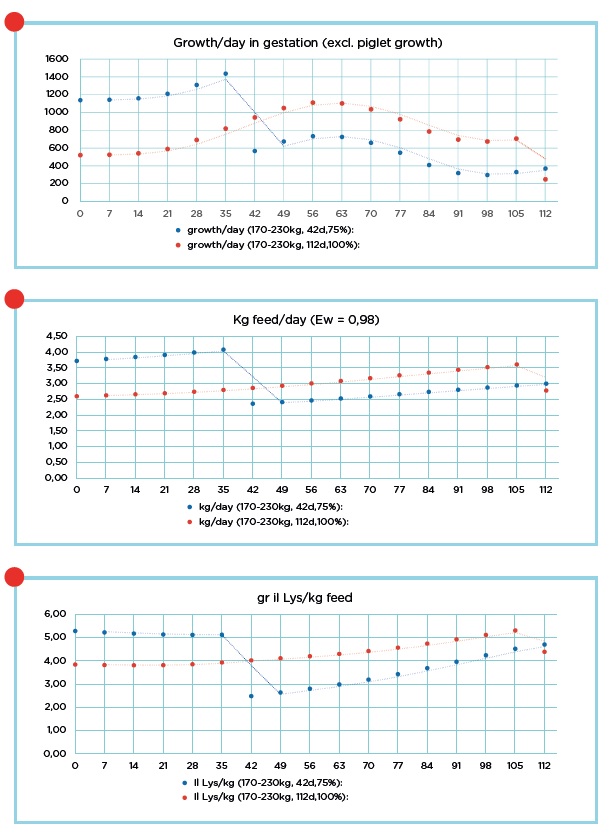
As illustrated in Tables 1 and 2, high-performing sows and young first-parity sows benefit from achieving most of their recovery and body development during the first weeks of gestation. In our model, approximately 75% of the required maternal growth is achieved within the first 42 days of pregnancy. This results in substantially higher nutrient requirements during early gestation compared with a more evenly distributed growth pattern.
For these animals, the demand for energy, amino acids and particularly lysine can be considerably higher during the first phase of gestation. Supporting recovery early provides the sow with a stronger foundation for the remainder of pregnancy and the upcoming lactation.
This approach is particularly relevant for:
- First-parity sows that are still growing;
- Highly prolific sows recovering from a demanding lactation;
- Thin sows that require body condition recovery after weaning.
Older parity sows in good body condition may have significantly lower recovery requirements and therefore benefit from a different feeding strategy.
The comparisons shown in the tables highlight an important message: not all gestating sows should be fed identically. Assessing body condition at insemination and again at pregnancy confirmation allows producers to make more targeted feeding decisions and support both sow longevity and litter performance.
Mid-Gestation: Consistency Matters
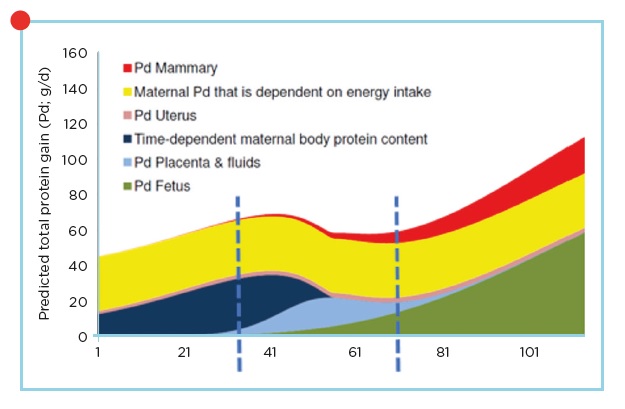
The middle stage of gestation is often overlooked, yet it plays a vital role in supporting the development of healthy and robust piglets. While much of the sow's weight gain during this period consists of fluids, important physiological processes are taking place behind the scenes.
As shown in Table X, the development of the placenta and umbilical cord continues throughout mid-gestation. These structures are the lifeline between the sow and her unborn piglets, supplying all nutrients required for fetal development. As a result, underfeeding during this period can negatively affect piglet vitality and birth outcomes.
On many farms, a high-low-high feeding strategy is still applied during gestation. In group housing systems, however, reducing feed allowance too much in mid-gestation may increase the risk that less dominant sows consume insufficient nutrients. For this reason, a more consistent feeding approach throughout mid- and late gestation is often preferred.
Late Gestation: Preparing the Sow for Farrowing
During the final weeks of gestation, fetal growth accelerates rapidly. Large litters can gain well over one kilogram of combined weight per day during the last phase of pregnancy. However, despite this significant demand, it is not always beneficial to continually increase feed allowance.
At this stage, the sow's natural ability to mobilise body reserves becomes increasingly important. Rather than trying to provide every required nutrient through additional feed, the objective should be to maintain optimal body condition and prepare the sow for both farrowing and the upcoming lactation.
A fit and well-conditioned sow can effectively utilise her body reserves to support litter development while maintaining her own performance. Overfeeding during late gestation offers limited benefits and may negatively affect feed intake after farrowing.
Practical Feeding Recommendations
- Adjust feeding according to body condition
Assess sow condition at key stages such as insemination and pregnancy confirmation, and adapt feed levels accordingly. Practical management tools, including colour-based grouping systems, can help make individual feeding decisions both efficient and easy to implement. - Avoid underfeeding during mid-gestation
Ensure all sows, particularly in group housing systems, receive sufficient nutrients to support placental development and fetal growth. - Focus on condition rather than maximum feed intake
In late gestation, the goal is to maintain a fit sow capable of supporting litter development through both nutritional intake and natural body reserve mobilisation.
Nutritional Considerations
Review the role of multiple gestation diets
The nutritional requirements of modern sows suggest that feeding programmes should focus less on traditional early- and late-gestation diet changes and more on supporting specific sow categories. Where multiple gestation diets are used, differentiation based on recovery needs or first-parity development may provide greater value.
Support metabolic function
Sows rely on complex metabolic processes throughout gestation. Adequate levels of vitamins, trace minerals and highly available nutrients are therefore essential to support recovery, fetal development and preparation for lactation.
By combining targeted nutrition with practical feeding management, producers can support sow longevity, improve litter quality and build a stronger foundation for future performance.
About the author

Huub Derix
Swine Nutritionist