
Feed intake after weaning predicts piglet performance
Early feed intake determines future performance
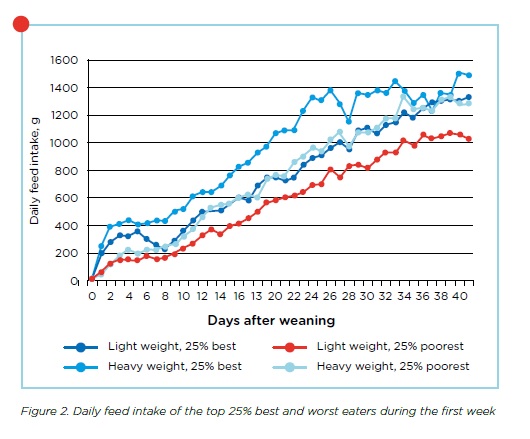
The period immediately after weaning is one of the most challenging phases in a piglet's life. Feed intake during these first days has a major impact on growth, health and overall development. Recent research confirms that piglets that start eating well shortly after weaning are more likely to maintain higher intake levels throughout the following weeks. A trial involving 100 weaned piglets provided detailed insights into individual feeding behaviour and its relationship with performance. The piglets were housed in pens equipped with individual feeding and weighing stations, allowing researchers to accurately monitor both feed intake and body weight development.

Different starting weights, similar conclusions
The study included two groups:
- Light piglets with an average weight of 6.3 kg
- Heavy piglets with an average weight of 10.2 kg
Although both groups differed significantly in body weight, one conclusion applied to all piglets: intake during the first week strongly influenced feed consumption during the remainder of the trial period.
Piglets that consumed more feed in the first week consistently maintained higher intake levels afterwards. This underlines the importance of encouraging feed consumption immediately after weaning.
Transport already causes weight loss
Before entering the trial, piglets experienced approximately five hours of transport.
Both weight categories lost between 2.5% and 3.0% of their body weight during transport. This highlights the stress piglets experience before arriving at their new environment and explains why rapid recovery of feed intake after weaning is so important.
Feed intake helps predict health challenges
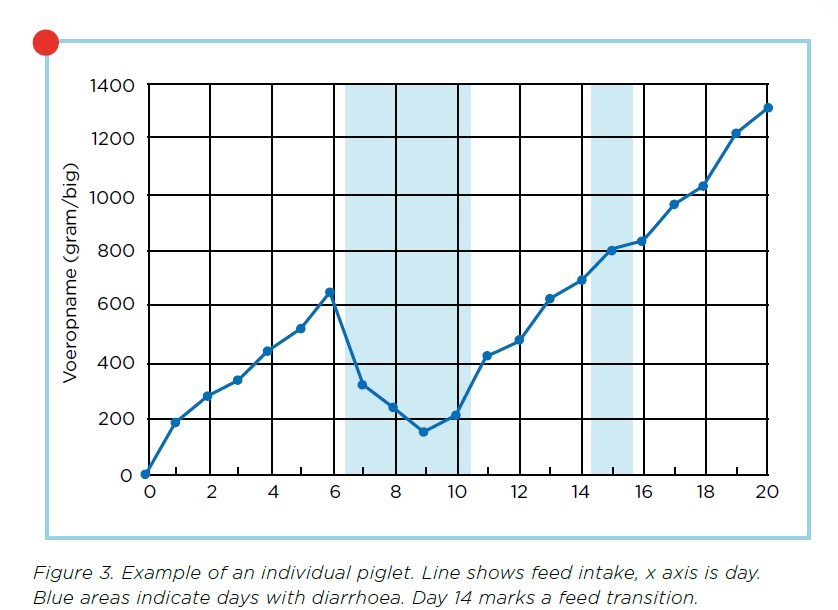
Researchers observed a clear relationship between feed intake patterns and the occurrence of diarrhoea.
Most diarrhoea cases appeared between days 6 and 10 after weaning. Interestingly, a slowdown in feed intake growth was already visible several days earlier. This suggests that monitoring feed intake can help identify potential health challenges before clinical symptoms become obvious.
For producers, feed intake monitoring can therefore be a valuable management tool for early intervention.
Understanding piglet feeding behaviour
The study also revealed consistent feeding patterns throughout the day.
Most feed was consumed during the early evening hours, although approximately one-third of total intake occurred during the night. This effect was particularly noticeable in lighter piglets.
Understanding these natural feeding rhythms enables producers to optimise:
- Feeding schedules
- Feeder refilling times
- Inspection routines
- Lighting programmes
Aligning management practices with natural piglet behaviour can contribute to better intake and improved performance.
Lighter piglets require additional attention
Compared to heavier piglets, lighter animals visited feeders more frequently but consumed smaller quantities per visit.
As a result, lighter piglets benefit from:
- More feeding space
- Longer access to additional feeders after weaning
- More frequent feed availability
Providing these piglets with extra opportunities to eat can help support intake and reduce performance gaps within the group.
Practical recommendations for successful weaning
Based on the trial results, several management strategies can support optimal feed intake:
1. Group piglets according to body weight
Separate lighter and heavier piglets where possible and adapt management accordingly.
2. Encourage feed intake during the first week
The first week remains the most important period for establishing future performance.
3. Consider night-time activity
Providing suitable lighting can support feeding behaviour during evening and night hours.
4. Ensure sufficient feeder access
Lighter piglets especially benefit from additional feeding opportunities.
5. Monitor intake closely
Changes in intake can provide an early indication of health issues and help optimise feeding transitions.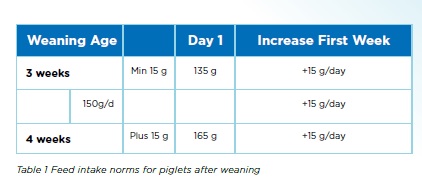
Conclusion
Feed intake during the first week after weaning remains one of the strongest indicators of future piglet performance. Monitoring intake patterns provides valuable information about growth potential, feeding behaviour and possible health challenges. By combining targeted nutrition with management practices that support early feed consumption, producers can create the conditions for healthier and more productive piglets.
About the author

Bram Bronsvoort
Specialist Swine